

How Do Pollsters Draw A Representative Sample?
Sampling Methods | Types and Techniques Explained
When yous behave research about a grouping of people, information technology's rarely possible to collect data from every person in that grouping. Instead, yous select a sample. The sample is the grouping of individuals who volition actually participate in the inquiry.
To describe valid conclusions from your results, you have to carefully determine how you volition select a sample that is representative of the group as a whole. There are two types of sampling methods:
- Probability sampling involves random selection, assuasive you to make strong statistical inferences nearly the whole group.
- Non-probability sampling involves non-random selection based on convenience or other criteria, allowing you to easily collect data.
You should clearly explicate how you lot selected your sample in the methodology section of your newspaper or thesis.
Population vs sample
Beginning, you need to understand the deviation between a population and a sample, and identify the target population of your enquiry.
- The population is the entire group that you want to describe conclusions about.
- The sample is the specific grouping of individuals that you volition collect data from.
The population can exist defined in terms of geographical location, age, income, and many other characteristics.
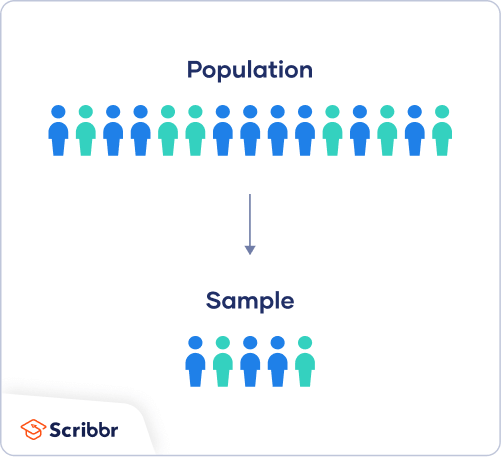 It can exist very broad or quite narrow: peradventure you lot want to make inferences about the whole developed population of your country; maybe your inquiry focuses on customers of a certain company, patients with a specific health condition, or students in a single school.
It is important to advisedly define your target population according to the purpose and practicalities of your project.
If the population is very large, demographically mixed, and geographically dispersed, it might be hard to gain access to a representative sample.
Sampling frame
The sampling frame is the actual list of individuals that the sample volition be drawn from. Ideally, it should include the entire target population (and nobody who is not role of that population).
Example
You are doing inquiry on working conditions at Company X. Your population is all 1000 employees of the visitor. Your sampling frame is the visitor's HR database which lists the names and contact details of every employee.
Sample size
The number of individuals you lot should include in your sample depends on various factors, including the size and variability of the population and your enquiry pattern. There are different sample size calculators and formulas depending on what you want to reach with statistical assay.
Probability sampling methods
Probability sampling means that every member of the population has a take a chance of being selected. It is mainly used in quantitative inquiry. If you want to produce results that are representative of the whole population, probability sampling techniques are the most valid choice.
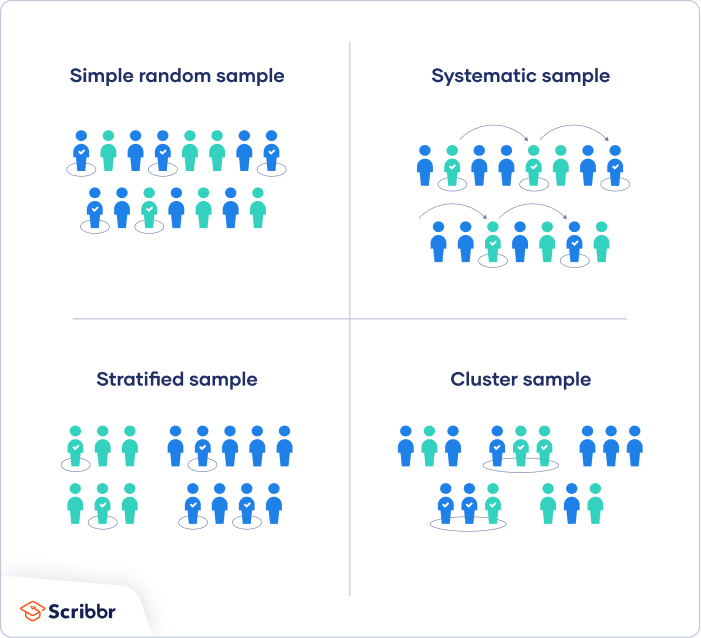
There are iv main types of probability sample.
one. Simple random sampling
In a elementary random sample, every fellow member of the population has an equal chance of being selected. Your sampling frame should include the whole population.
To conduct this type of sampling, you lot tin can utilize tools like random number generators or other techniques that are based entirely on chance.
Example
You want to select a simple random sample of 100 employees of Company X. Y'all assign a number to every employee in the visitor database from i to thousand, and utilise a random number generator to select 100 numbers.
2. Systematic sampling
Systematic sampling is similar to simple random sampling, but it is usually slightly easier to conduct. Every fellow member of the population is listed with a number, but instead of randomly generating numbers, individuals are chosen at regular intervals.
Example
All employees of the visitor are listed in alphabetical order. From the first ten numbers, you randomly select a starting signal: number 6. From number six onwards, every tenth person on the listing is selected (6, sixteen, 26, 36, and so on), and you stop up with a sample of 100 people.
If you use this technique, it is important to make sure that there is no subconscious design in the listing that might skew the sample. For example, if the HR database groups employees by team, and team members are listed in society of seniority, there is a adventure that your interval might skip over people in junior roles, resulting in a sample that is skewed towards senior employees.
iii. Stratified sampling
Stratified sampling involves dividing the population into subpopulations that may differ in important ways. It allows you lot draw more than precise conclusions by ensuring that every subgroup is properly represented in the sample.
To use this sampling method, you divide the population into subgroups (called strata) based on the relevant feature (east.m. gender, age range, income bracket, job role).
Based on the overall proportions of the population, you summate how many people should exist sampled from each subgroup. Then y'all apply random or systematic sampling to select a sample from each subgroup.
Example
The visitor has 800 female employees and 200 male employees. You lot want to ensure that the sample reflects the gender balance of the visitor, so you lot sort the population into 2 strata based on gender. Then you use random sampling on each grouping, selecting 80 women and xx men, which gives you a representative sample of 100 people.
4. Cluster sampling
Cluster sampling also involves dividing the population into subgroups, just each subgroup should have like characteristics to the whole sample. Instead of sampling individuals from each subgroup, you lot randomly select unabridged subgroups.
If information technology is practically possible, you might include every private from each sampled cluster. If the clusters themselves are big, you lot tin also sample individuals from within each cluster using ane of the techniques above. This is chosen multistage sampling.
This method is good for dealing with large and dispersed populations, but there is more risk of fault in the sample, every bit at that place could be substantial differences betwixt clusters. It's difficult to guarantee that the sampled clusters are really representative of the whole population.
Example
The visitor has offices in 10 cities across the country (all with roughly the aforementioned number of employees in similar roles). You don't take the capacity to travel to every part to collect your data, so you utilise random sampling to select 3 offices – these are your clusters.
Receive feedback on linguistic communication, structure and formatting
Professional person editors proofread and edit your paper past focusing on:
- Academic style
- Vague sentences
- Grammer
- Manner consistency
See an example

Non-probability sampling methods
In a non-probability sample, individuals are selected based on non-random criteria, and not every individual has a take a chance of existence included.
This type of sample is easier and cheaper to access, but it has a college chance of sampling bias. That means the inferences you tin make near the population are weaker than with probability samples, and your conclusions may be more than express. If you use a not-probability sample, you should still aim to brand it as representative of the population every bit possible.
Not-probability sampling techniques are frequently used in exploratory and qualitative research. In these types of research, the aim is not to exam a hypothesis nigh a wide population, simply to develop an initial understanding of a pocket-size or under-researched population.
1. Convenience sampling
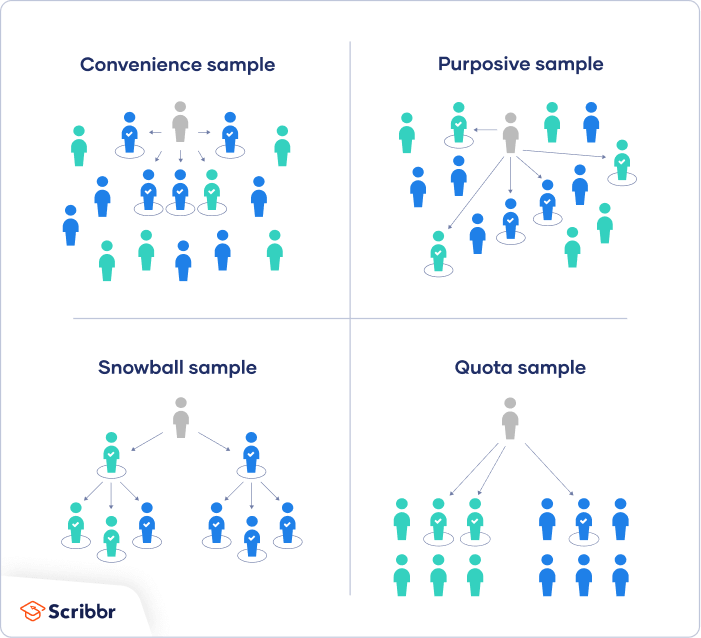
A convenience sample but includes the individuals who happen to exist virtually accessible to the researcher.
This is an easy and inexpensive fashion to gather initial data, only there is no fashion to tell if the sample is representative of the population, so it can't produce generalizable results.
Example
You are researching opinions about educatee support services in your academy, so after each of your classes, you ask your beau students to consummate a survey on the topic. This is a convenient way to gather data, merely every bit y'all only surveyed students taking the same classes as you at the same level, the sample is not representative of all the students at your university.
2. Voluntary response sampling
Similar to a convenience sample, a voluntary response sample is mainly based on ease of admission. Instead of the researcher choosing participants and direct contacting them, people volunteer themselves (e.g. past responding to a public online survey).
Voluntary response samples are always at least somewhat biased, equally some people will inherently be more probable to volunteer than others.
Instance
You send out the survey to all students at your academy and a lot of students decide to complete information technology. This can certainly give y'all some insight into the topic, only the people who responded are more likely to exist those who have potent opinions near the student support services, then you can't be certain that their opinions are representative of all students.
3. Purposive sampling
This type of sampling, likewise known as judgement sampling, involves the researcher using their expertise to select a sample that is near useful to the purposes of the research.
It is often used in qualitative enquiry, where the researcher wants to gain detailed knowledge near a specific phenomenon rather than make statistical inferences, or where the population is very small and specific. An constructive purposive sample must have articulate criteria and rationale for inclusion.
Example
You desire to know more than well-nigh the opinions and experiences of disabled students at your university, so you lot purposefully select a number of students with different back up needs in lodge to gather a varied range of data on their experiences with educatee services.
4. Snowball sampling
If the population is hard to admission, snowball sampling can be used to recruit participants via other participants. The number of people you accept admission to "snowballs" as you get in contact with more people.
Example
You are researching experiences of homelessness in your city. Since in that location is no listing of all homeless people in the city, probability sampling isn't possible. Yous meet one person who agrees to participate in the research, and she puts you in contact with other homeless people that she knows in the area.
Frequently asked questions about sampling
- What is sampling?
-
A sample is a subset of individuals from a larger population. Sampling means selecting the group that y'all will actually collect data from in your research. For example, if you are researching the opinions of students in your academy, yous could survey a sample of 100 students.
In statistics, sampling allows you to test a hypothesis most the characteristics of a population.
- What is not-probability sampling?
-
In non-probability sampling, the sample is selected based on non-random criteria, and not every member of the population has a chance of being included.
Common non-probability sampling methods include convenience sampling, voluntary response sampling, purposive sampling, snowball sampling, and quota sampling.
- What is multistage sampling?
-
In multistage sampling, or multistage cluster sampling, yous draw a sample from a population using smaller and smaller groups at each phase.
This method is often used to collect information from a large, geographically spread group of people in national surveys, for example. Yous take advantage of hierarchical groupings (due east.g., from state to urban center to neighborhood) to create a sample that's less expensive and fourth dimension-consuming to collect data from.
Is this article helpful?
You lot accept already voted. Thank you :-) Your vote is saved :-) Processing your vote...

Source: https://www.scribbr.com/methodology/sampling-methods/
Posted by: limaftere1980.blogspot.com
0 Response to "How Do Pollsters Draw A Representative Sample?"
Post a Comment