

How Much Do Vehicle Charging Systions Draw
A charging station, also chosen an EV charger or electric vehicle supply equipment (EVSE), is a piece of equipment that supplies electric power for charging plug-in electrical vehicles (including hybrids, neighborhood electrical vehicles, trucks, buses, and others).
Although batteries tin can only be charged with DC power, nearly electric vehicles have an onboard AC-to-DC converter that allows them to be plugged into a standard household AC electric receptacle. Inexpensive low-ability public charging stations will likewise provide AC power, known as "Air conditioning charging stations". To facilitate higher power charging, which requires much larger Air conditioning-to-DC converters, the converter is congenital into the charging station instead of the vehicle and the station supplies already-converted DC power directly to the vehicle, bypassing the vehicle'south onboard converter. These are known equally "DC charging stations". Most fully electrical car models tin can accept both AC and DC power.
Charging stations provide connectors that accommodate to a multifariousness of standards. DC charging stations are commonly equipped with multiple connectors to exist able to supply a wide diversity of vehicles.
Public charging stations are typically establish street-side or at retail shopping centers, government facilities, and other parking areas.
Standards [edit]
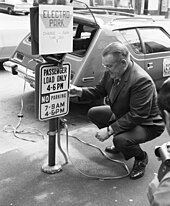
Multiple standards have been established for charging engineering science to enable interoperability across vendors. Standards are available for nomenclature, power and connectors. Notably, Tesla has developed proprietary engineering science in these areas.
Nomenclature [edit]

Charging station and vehicle terminology
The European Machine Manufacturers Clan (ACEA) has defined the following terms:[ii]
- Socket outlet: the port on the electrical vehicle supply equipment (EVSE) that supplies charging power to the vehicle
- Plug: the end of the flexible cablevision that interfaces with the socket outlet on the EVSE. In North America, the socket outlet and plug are not used because the cable is permanently attached to the EVSE.
- Cable: a flexible packet of conductors that connects the EVSE with the electric vehicle
- Connector: the opposite terminate of the flexible cable that interfaces with the vehicle inlet
- Vehicle inlet: the port on the electric vehicle that receives charging power
The terms "electric vehicle connector" and "electric vehicle inlet" were previously divers in the aforementioned way under Article 625 of the National Electric Lawmaking (NEC) of 1999. NEC-1999 besides divers the term "electric vehicle supply equipment" every bit the entire unit of measurement "installed specifically for the purpose of delivering energy from the premises wiring to the electric vehicle", including "conductors ... electric vehicle connectors, attachment plugs, and all other fittings, devices, power outlets, or apparatuses".[three]
Voltage and Power [edit]
Early standards [edit]
| Method | Maximum supply | ||
|---|---|---|---|
| Current (A) | Voltage (5) | Power (kW) | |
| Level 1 (1Φ Ac) | 12 | 120 | 1.44 |
| 16 | 120 | 1.92 | |
| 24 | 120 | ii.88 | |
| Level 2 (1Φ Air-conditioning) | 32 | 208/240 | seven.68 |
| Level 3 (3Φ Ac) | 400 | 480 | 332.six |
The National Electrical Transportation Infrastructure Working Quango (IWC) was formed in 1991 by the Electrical Power Research Found with members drawn from automotive manufacturers and the electric utilities to ascertain standards in the Us;[5] early work by the IWC led to the definition of 3 levels of charging in the 1999 National Electric Code (NEC) Handbook.[four] : ix
Under NEC-1999, Level ane charging equipment was connected to the grid through a standard NEMA 5-20R iii-prong electric outlet with grounding, and a basis-fault circuit interrupter was required within 12 in (300 mm) of the plug. The supply circuit required protection at 125% of maximum rated electric current, so for example charging equipment rated at 16 A continuous current required a breaker sized to twenty A.[4] : 9
Level 2 charging equipment was permanently wired and fastened at a stock-still location nether NEC-1999. It also required grounding and ground-mistake protection; in improver, it required an interlock to forbid vehicle startup during charging and a safety breakaway for the cable and connector. A xl A breaker (125% of continuous maximum supply current) was required to protect the branch circuit.[four] : 9 For convenience and speedier charging, many early EVs preferred that owners and operators install Level ii charging equipment, which was connected to the EV either through an inductive paddle (Magne Charge) or a conductive connector (AVCON).[iv] : x–11, 18
Level 3 charging equipment used an off-vehicle rectifier to convert the input Air-conditioning power to DC, which was then supplied to the vehicle. A 500 A billow (125% of continuous maximum supply current) was required to protect the branch circuit. At the time it was written, NEC-1999 anticipated that Level 3 charging equipment would require utilities to upgrade their distribution systems and transformers.[4] : 9
SAE [edit]
| Method | Maximum supply | ||
|---|---|---|---|
| Electric current (A) | Voltage (V) | Ability (kW) | |
| AC Level 1 | 12 | 120 | 1.44 |
| 16 | 120 | 1.92 | |
| AC Level 2 | fourscore | 208–240 | nineteen.ii |
| DC Level 1 | 80 | fifty–yard | eighty |
| DC Level 2 | 400 | 50–grand | 400 |
The Society of Automotive Engineers (SAE International) defines the full general physical, electrical, communication and functioning requirements for EV charging systems used in N America, as part of standard SAE J1772.[7] SAE J1772 defines four levels of charging, two levels each for AC and DC supplies; the differences betwixt levels are based upon the power distribution type, standards and maximum ability.
Alternating Electric current (Ac) [edit]
AC charging stations connect the vehicle'southward onboard charging circuitry directly to the Ac Supply.[seven]
- AC Level i: Connects directly to a standard 120V North American residential outlet; capable of supplying half-dozen–16A (0.seven–one.92kW) depending on the capacity of a defended circuit.
- Air conditioning Level 2: Utilizes 240V residential or 208Five commercial ability to supply between 6 and 80A (1.4–xix.iikW). Information technology provides a significant charging speed increment over Level 1 AC charging.
Direct Current (DC) [edit]
Ordinarily, though incorrectly, called "Level 3" charging based on the older NEC-1999 definition, DC charging is categorized separately in the SAE standard. In DC fast-charging, grid power is passed through an Air-conditioning-to-DC rectifier before reaching the vehicle's battery, bypassing any onboard rectifier.[7] [8]
- DC Level 1: Supplies a maximum of 80kW at 50–thou5.
- DC Level 2: Supplies a maximum of 400kW at fifty–1000V.
Boosted standards released past SAE for charging include SAE J3068 (three-phase AC charging, using the Type 2 connector defined in IEC 62196-2) and SAE J3105 (automated connection of DC charging devices).
IEC [edit]
The International Electrotechnical Committee (IEC) adopted a bulk of the SAE J1772 standard under IEC 62196-one for international implementation.
| Mode | Type | Maximum supply | ||
|---|---|---|---|---|
| Electric current (A) | Voltage (V) | Power (kW) | ||
| 1 | 1Φ Ac | 16 | 250 | 4 |
| 3Φ AC | sixteen | 480 | 11 | |
| 2 | 1Φ AC | 32 | 250 | 7,4 |
| 3Φ AC | 32 | 480 | 22 | |
| three | 1Φ Ac | 63 | 250 | fourteen,5 |
| 3Φ Air-conditioning | 63 | 480 | 43,5 | |
| 4 | DC | 200 | 400 | eighty |
The IEC alternatively defines charging in modes (IEC 61851-i):
- Mode 1: tiresome charging from a regular electrical socket (single- or three-phase AC)
- Manner 2: ho-hum charging from a regular AC socket but with some EV specific protection arrangement (i.e. the Park & Charge or the PARVE systems)
- Manner 3: slow or fast Ac charging using a specific EV multi-pin socket with control and protection functions (i.due east. SAE J1772 and IEC 62196-2)
- Mode 4: DC fast charging using a specific charging interface (i.due east. IEC 62196-3, such as CHAdeMO)
The connexion between the electric grid and "charger" (electric vehicle supply equipment) is defined by 3 cases (IEC 61851-1):
- Example A: any charger connected to the mains (the mains supply cable is usually attached to the charger) usually associated with modes ane or ii.
- Instance B: an on-lath vehicle charger with a mains supply cable that can be detached from both the supply and the vehicle – ordinarily mode 3.
- Case C: DC dedicated charging station. The mains supply cable may be permanently attached to the charge station as in fashion four.
Tesla [edit]
In North America, Tesla vehicles use a proprietary charging port; to meet EU requirements on recharging points,[12] Tesla vehicles sold there are equipped with an CCS Combo ii port. Either port will take 480V DC fast charging through its network of Tesla Superchargers. Depending on the Supercharger version, power is supplied at 72, 150, or 250 kW, corresponding to DC Levels i and 2 of SAE J1772. For a Tesla Model S, a supercharger can add around 275 km (170 miles) of range in most 30 minutes.[13] As of Q4 2021, Tesla reported three,476 supercharging stations.[14]
Hereafter development [edit]
An extension to the CCS DC fast-charging standard for electrical cars and light trucks is under development, which will provide higher ability charging for big commercial vehicles (Class 8, and possibly 6 and 7 every bit well, including school and transit buses). When the CharIN job force was formed in March 2018, the new standard being developed was originally called High Power Charging for Commercial Vehicles (HPCCV),[15] afterward renamed Megawatt Charging System (MCS). MCS is expected to operate in the range of 200–15005 and 0–3000A for a theoretical maximum power of four.5MW. The proposal calls for MCS charge ports to be compatible with existing CCS and HPC chargers.[sixteen] The job force released aggregated requirements in February 2019, which called for maximum limits of one thousandV DC (optionally, 1500V DC) and 3000A continuous rating.[17]
A connector blueprint was selected in May 2019[15] and tested at the National Renewable Energy Laboratory (NREL) in September 2020. Thirteen manufacturers participated in the test, which checked the coupling and thermal performance of seven vehicle inlets and eleven charger connectors.[xviii] The concluding connector requirements and specification are expected to be released in belatedly 2021.[nineteen]
With support from Portland General Electric, on 21 April 2021 Daimler Trucks North America opened the "Electric Isle", the beginning heavy-duty vehicle charging station, across the street from its headquarters in Portland, Oregon. The station is capable of charging eight vehicles simultaneously, and the charging bays are sized to accommodate tractor-trailers. In addition, the design is capable of accommodating 1+MW chargers one time they are available.[twenty] A startup visitor, WattEV, appear plans in May 2021 to build a 40-stall truck cease/charging station in Bakersfield, California; at total chapters, it would provide a combined 25MW of charging power, partially drawn from an on-site solar array and battery storage.[21]
Connectors [edit]

IEC Blazon 4/
Common connectors include Type ane (Yazaki), Blazon 2 (Mennekes), Type 3 (Scame), CCS Philharmonic 1 and 2, CHAdeMO, and Tesla.[22] [23] Many standard plug types are divers in IEC 62196-2 (for AC supplied ability) and 62196-3 (for DC supplied power):
- Type one: single-phase AC vehicle coupler – SAE J1772/2009 automotive plug specifications
- Blazon 2: single- and 3-phase Air conditioning vehicle coupler – VDE-AR-Due east 2623-two-ii, SAE J3068, and GB/T 20234.2 plug specifications
- Type three: single- and iii-stage Air-conditioning vehicle coupler equipped with safety shutters – EV Plug Alliance proposal
- Type 4: DC fast accuse couplers
- Configuration AA: CHAdeMO
- Configuration BB: GB/T 20234.iii
- Configurations CC/DD: (reserved)
- Configuration EE: CCS Combo 1
- Configuration FF: CCS Philharmonic 2
| Power Supply | Usa | European Matrimony | Japan | China |
|---|---|---|---|---|
| 1-phase Air conditioning (62196.two) |  Type 1 (SAE J1772) |  Type 2 (DE, United kingdom)
| Type i (SAE J1772) | 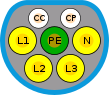 Type 2 (GB/T 20234.2) |
| 3-phase AC (62196.2) | Type 2 (SAE J3068) | N/A | ||
| DC (62196.iii) |  EE (CCS Combo 1) |  FF (CCS Philharmonic two) | 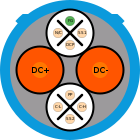 AA (CHAdeMO) |  BB (GB/T 20234.three) |
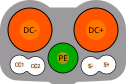 ChaoJi(planned) | ||||

CCS DC charging requires Powerline Communications (PLC). Two connectors are added at the lesser of Type ane or Type two vehicle inlets and charging plugs to supply DC current. These are commonly known as Combo 1 or Philharmonic 2 connectors. The choice of style inlets is ordinarily standardized on a per-country basis so that public chargers exercise not need to fit cables with both variants. Generally, North America uses Combo 1 style vehicle inlets, while most of the residue of the globe uses Combo ii.
The CHAdeMO standard is favored past Nissan, Mitsubishi, and Toyota, while the SAE J1772 Combo standard is backed past GM, Ford, Volkswagen, BMW, and Hyundai. Both systems accuse to 80% in approximately 20 minutes, but the two systems are completely incompatible. Richard Martin, editorial director for clean applied science marketing and consultant business firm Navigant Enquiry, stated:
The broader conflict between the CHAdeMO and SAE Combo connectors, we meet that as a hindrance to the market over the side by side several years that needs to exist worked out.[24]
Historical connectors [edit]

Public charging stations in a parking lot near Los Angeles International Airport. Shown are two obsolete 6kW AC charging stations (left: inductive Magne-accuse gen2 SPI ("small paddle"), right: conductive EVII ICS-200 AVCON).
In the United States, many of the EVs kickoff marketed in the belatedly 1990s and early 2000s such every bit the GM EV1, Ford Ranger EV, and Chevrolet S-10 EV preferred the utilize of Level 2 (single-phase Air conditioning) EVSE, as defined under NEC-1999, to maintain adequate charging speed. These EVSE were fitted with either an inductive connector (Magne Accuse) or a conductive connector (generally Avcon). Proponents of the inductive organisation were GM, Nissan, and Toyota; DaimlerChrysler, Ford, and Honda backed the conductive system.[iv] : x–11
Magne Charge paddles were bachelor in two different sizes: an older, larger paddle (used for the EV1 and South-10 EV) and a newer, smaller paddle (used for the first-generation Toyota RAV4 EV, but backwards compatible with big-paddle vehicles through an adapter).[25] The larger paddle (introduced in 1994) was required to accommodate a liquid-cooled vehicle inlet accuse port; the smaller paddle (introduced in 2000) interfaced with an air-cooled inlet instead.[26] [27] : 23 SAE J1773, which described the technical requirements for inductive paddle coupling, was starting time issued in January 1995, with another revision issued in November 1999.[27] : 26
The influential California Air Resources Board adopted the conductive connector as its standard on 28 June 2001, based on lower costs and durability,[28] and the Magne Accuse paddle was discontinued by the following March.[29] Three conductive connectors existed at the fourth dimension, named according to their manufacturers: Avcon (aka butt-and-pin, used past Ford, Solectria, and Honda); Yazaki (aka pin-and-sleeve, on the RAV4 EV); and ODU (used by DaimlerChrysler).[27] : 22 The Avcon butt-and-pin connector supported Level 2 and Level 3 (DC) charging and was described in the appendix of the start version (1996) of the SAE J1772 recommended practice; the 2001 version moved the connector description into the body of the practice, making it the de facto standard for the United States.[27] : 25 [30] IWC recommended the Avcon butt connector for N America,[27] : 22 based on environmental and durability testing.[31] As implemented, the Avcon connector used four contacts for Level 2 (L1, L2, Airplane pilot, Basis) and added v more (three for serial communications, and ii for DC power) for Level 3 (L1, L2, Pilot, Com1, Com2, Ground, Clean Data ground, DC+, DC-).[32] By 2009, J1772 had instead adopted the round pivot-and-sleeve (Yazaki) connector equally its standard implementation, and the rectangular Avcon butt connector was rendered obsolete.[33]
Charging time [edit]

BYD e6. Able to recharge the bombardment in fifteen minutes to 80%
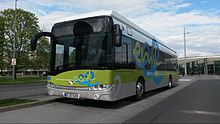
Charging time basically depends on the battery's capacity, power density, and charging ability. The larger the capacity, the more charge the battery can hold (analogous to the size of a fuel tank). Higher power density allows the battery to accept more than charge/unit time (the size of the tank opening). Higher charging ability supplies more free energy per unit time (coordinating to a pump's menstruation rate). An important downside of charging at fast speeds is that it also stresses the mains electricity grid more.[34]
California Air Resource Board specified a target to authorize every bit a zero-emission vehicle: add 200 miles (320 km) in under 15 minutes. The intent was to match the refueling expectations of internal combustion engine drivers.
Accuse time can be calculated equally:[35]

The effective charging power tin exist lower than the maximum charging power due to limitations of the battery or battery management system, charging losses (which tin be equally high as 25%[36]), and vary over time due to charging limits practical by a accuse controller.
Battery capacity [edit]
The usable battery capacity of a first-generation electric vehicle, such as the original Nissan Leaf, was about xxkWh, giving information technology a range of about 100 mi (160 km). Tesla was the first visitor to introduce longer-range vehicles, initially releasing their Model Southward with bombardment capacities of 40kWh, threescorekWh and 85kWh, with the latter lasting for about 480 km (300 mi). Plug-in hybrid vehicles typically have chapters of roughly 3 to 20kWh, lasting for twenty to 80 kilometers (12 to l miles).
AC to DC conversion [edit]
Batteries are charged with DC power. To charge from the AC ability supplied by the electrical filigree, EVs have a small AC-to-DC converter built into the vehicle. The charging cable supplies AC ability from the wall, and the vehicle converts this power to DC internally and charges its battery. The congenital-in converters on most EVs typically support charging speeds up to 6–sevenkW, sufficient for overnight charging. This is known as "Ac charging". To facilitate rapid recharging of EVs, much higher ability (fifty–100kW+) is necessary. This requires a much larger AC-to-DC converter which is non applied to integrate into the vehicle. Instead, the AC-to-DC conversion is performed by the charging station, and DC ability is supplied to the vehicle directly, bypassing the congenital-in converter. This is known every bit DC fast charging.
| Configuration | Voltage | Current | Ability | Charging time | Comment |
|---|---|---|---|---|---|
| Unmarried-phase AC | 1205 | 12A | 1.44kW | 13hours | This is the maximum continuous ability bachelor from a standard The states/Canadian 120Five fifteenA excursion |
| Unmarried-phase AC | 230V | 12A | ii.76kW | half-dozen.viiihours | This is the maximum continuous power bachelor from a CEE 7/3 ("Schuko") receptacle on a 16A rated circuit |
| Single-phase Air conditioning | 240Five | 30A | 7.20kW | two.6hours | Common maximum limit of public AC charging stations used in Due north America, such as a ChargePoint CT4000 |
| Three-phase AC | 400V | sixteenA | xi.0kW | 1.7hours | Maximum limit of a European 16A iii-phase AC charging station |
| Three-phase Air conditioning | 400Five | 32A | 22.1kW | 51minutes | Maximum limit of a European 32A iii-phase AC charging station |
| DC | 4005 | 125A | lkW | 22minutes | Typical mid-power DC charging station |
| DC | 400V | 300A | 120kW | 9minutes | Typical ability from a Tesla V2 Tesla Supercharger |
Safety [edit]

A Sunwin electric bus in Shanghai at a charging station

Charging stations are ordinarily accessible to multiple electric vehicles and are equipped with current or connection sensing mechanisms to disconnect the power when the EV is non charging.
The two main types of safety sensor:
- Electric current sensors monitor ability consumed, and maintain the connection but while demand is within a predetermined range.[ citation needed ]
- Sensor wires provide a feedback signal such every bit specified by the SAE J1772 and IEC 62196 schemes that require special (multi-pin) ability plug fittings.
Sensor wires react more quickly, have fewer parts to fail, and are possibly less expensive to blueprint and implement.[ commendation needed ] Current sensors however can use standard connectors and tin allow suppliers to monitor or charge for the electricity actually consumed.
Public charging stations [edit]

US traffic sign

Public-domain international sign
Longer drives require a network of public charging stations. In addition, they are essential for vehicles that lack access to a home charging station, as is mutual in multi-family housing. Costs vary greatly by country, power supplier and power source. Some services charge by the infinitesimal, while others charge by the amount of energy received (measured in kilowatt-hours).
Charging stations may not need much new infrastructure in developed countries, less than delivering a new fuel over a new network.[38] The stations can leverage the existing ubiquitous electrical grid.[39]
Charging stations are offered by public authorities, commercial enterprises and some major employers to accost range barriers. Options include simple charging posts for roadside use, charging cabinets for covered parking places and fully automated charging stations integrated with ability distribution equipment.[xl]
Every bit of December 2012[update], around 50,000 not-residential charging points were deployed in the U.Southward., Europe, Nihon and Red china.[41] Every bit of August 2014[update], some 3,869 CHAdeMO quick chargers were deployed, with 1,978 in Nihon, 1,181 in Europe and 686 in the United states of america, and 24 in other countries.[42]
Asia/Pacific [edit]
As of Dec 2012[update], Japan had 1,381 public DC fast-charging stations, the largest deployment of fast chargers in the world, just only around 300 AC chargers.[41] As of December 2012[update], China had effectually 800 public tedious charging points, and no fast charging stations.[41]
As of September 2013[update], the largest public charging networks in Australia were in the upper-case letter cities of Perth and Melbourne, with around thirty stations (7kW AC) established in both cities – smaller networks exist in other capital cities.[43]
-

Public charging park in Germany
-

Automobile charging bespeak in Scotland
Europe [edit]
As of Dec 2013[update], Estonia was the only country that had completed the deployment of an EV charging network with nationwide coverage, with 165 fast chargers available along highways at a maximum distance of between 40–60 km (25–37 mi), and a higher density in urban areas.[44] [45] [46]
As of Nov 2012[update], most 15,000 charging stations had been installed in Europe.[47]
As of March 2013[update], Norway had 4,029 charging points and 127 DC fast-charging stations.[48] As role of its commitment to environmental sustainability, the Dutch government initiated a plan to constitute over 200 fast (DC) charging stations beyond the country by 2015. The rollout will be undertaken past ABB and Dutch startup Fastned, aiming to provide at least one station every 50 km (31 mi) for the Netherlands' 16 million residents.[49] In addition to that, the E-laad foundation installed virtually 3000 public (boring) accuse points since 2009.[50]
Compared to other markets, such every bit China, the European electrical car market has adult slowly. This, together with the lack of charging stations, has reduced the number of electric models available in Europe.[51] In 2018 and 2019 the European Investment Bank (EIB) signed several projects with companies like Allego, Greenway, BeCharge and Enel Ten. The EIB loans will support the deployment of the charging station infrastructure with a total of €200 1000000.[51] The Britain government declared that it volition ban the selling of new petrol and diesel vehicles by 2035 for a complete shift towards electric charging vehicles.[52]
Northward America [edit]
As of August 2018[update], 800,000 electric vehicles and 18,000 charging stations operated in the United States,[53] upwards from v,678 public charging stations and xvi,256 public charging points in 2013.[54] [55] Past July 2020, Tesla had installed i,971 stations (17,467 plugs).[56]
As of Baronial 2019, in the U.S., there are two,140 CHAdeMO charging stations (3,010 plugs), one,888 SAE CCS1 charging stations (3,525 plugs), and 678 Tesla Supercharger stations (6,340 plugs), according to the U.South. Department of Energy'due south Culling Fuels Information Center.[57]
Colder areas such as Republic of finland, some northern U.s.a. states and Canada have some infrastructure for public power receptacles provided primarily for use by cake heaters. Although their excursion breakers foreclose large current draws for other uses, they can be used to recharge electric vehicles, albeit slowly.[58] In public lots, some such outlets are turned on only when the temperature falls below −20°C, farther limiting their value.[59]
In 2017, Tesla gave the owners of its Model S and Model 10 cars 400kWh of Supercharger credit,[60] although this varied over time. The price ranges from $0.06–0.26/kWh in the United States.[61] Tesla Superchargers are usable only past Tesla vehicles.
Other charging networks are available for all electric vehicles. The Blink network has both AC and DC charging stations and charges separate prices for members and non-members. Their prices range from $0.39–0.69/kWh for members and $0.49–0.79/kWh for non-members, depending on location.[62] The ChargePoint network has gratuitous chargers and paid chargers that drivers activate with a free membership card.[63] Prices are based on local rates. Other networks may have cash or a credit bill of fare.
Africa [edit]

S African based ElectroSA and automobile manufacturers including BMW, Nissan and Jaguar have so far been able to install fourscore electric machine charges nationwide.[64]
South America [edit]
In April 2017 YPF, the country-owned oil visitor of Argentina, reported that information technology will install 220 fast-load stations for electric vehicles in 110 of its service stations in the national territory.[65]
Projects [edit]


Detail of the wireless anterior charging device
Electric car manufacturers, charging infrastructure providers, and regional governments have entered into agreements and ventures to promote and provide electric vehicle networks of public charging stations.
The EV Plug Alliance[66] is an association of 21 European manufacturers that proposed an IEC norm and a European standard for sockets and plugs. Members (Schneider Electrical, Legrand, Scame, Nexans, etc.) claimed that the arrangement was safer considering they use shutters. Prior consensus was that the IEC 62196 and IEC 61851-1 standards have already established safety by making parts non-live when touchable.[67] [68] [69]
Bombardment swap [edit]
A battery swapping (or switching) station permit vehicles to commutation a discharged bombardment pack for a charged one, eliminating the charge interval. Battery swapping is common in electric forklift applications.[70]
History [edit]
The concept of an exchangeable bombardment service was proposed equally early as 1896. It was kickoff offered between 1910 and 1924, past Hartford Electric Light Company, through the GeVeCo battery service, serving electric trucks. The vehicle possessor purchased the vehicle, without a battery, from Full general Vehicle Company (GeVeCo), part-owned by General Electric.[71] The power was purchased from Hartford Electric in the form of an exchangeable battery. Both vehicles and batteries were designed to facilitate a fast commutation. The owner paid a variable per-mile charge and a monthly service fee to cover truck maintenance and storage. These vehicles covered more than 6 million miles.
Beginning in 1917, a similar service operated in Chicago for owners of Milburn Electric cars.[72] A rapid bombardment replacement system was implemented to service fifty electric buses at the 2008 Summer Olympics.[73]
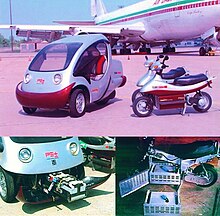
The SunRay and Caballito on their way to Micronesia for a briefing on global warming.
In 1993[74] Suntera developed a two-seat iii-wheel electric vehicle called the SUNRAY, which came with a battery cartridge that swapped out in minutes at a battery-swap station. In 1995, Suntera added a motor scooter.[75] The visitor was later renamed Personal Electric Transports[76](P.E.T.). After 2000 the visitor developed an electric bus. In 2004, the company's iii-wheel stand-up EV won 1st place at the 5-day long American Tour De Sol electric vehicle race,[77] before closing in 2006.
Better Identify, Tesla, and Mitsubishi Heavy Industries considered battery switch approaches.[78] [79] One complicating factor was that the approach requires vehicle design modifications.
In 2013, Tesla announced a proprietary charging station service. A network of Tesla Supercharger stations was envisioned to support both battery pack swaps and fast charging.[80] [81] Tesla later focused exclusively on fast-charging stations.[82]
Benefits [edit]
The following benefits were claimed for battery swapping:
- "Refueling" in nether 5 minutes.[83] [84]
- Automation: The driver can stay in the automobile while the bombardment is swapped.[85]
- Switch company subsidies could reduce prices without involving vehicle owners.[86]
- Spare batteries could participate in vehicle to grid energy services.[ commendation needed ]
Providers [edit]
The Better Place network was the first modernistic attempt at the battery switching model. The Renault Fluence Z.Eastward. was the start car enabled to adopt the approach and was offered in Israel and Denmark.[87]
Amend Place launched its first battery-swapping station in Israel, in Kiryat Ekron, near Rehovot in March 2011. The substitution process took v minutes.[83] [88] Better Identify filed for defalcation in Israel in May 2013.[89] [ninety]
In June 2013, Tesla announced its programme to offering battery swapping. Tesla showed that a battery swap with the Model Southward took just over 90 seconds.[84] [91] Elon Musk said the service would be offered at effectually US$threescore to U.s.a.$80 at June 2013 prices. The vehicle buy included one bombardment pack. After a swap, the possessor could after render and receive their battery pack fully charged. A 2nd option would be to keep the swapped battery and receive/pay the difference in value betwixt the original and the replacement. Pricing was not announced.[84] In 2015 the company abased the idea for lack of customer interest.[92]
-

Delta's DC EV Quick Charger installed in New Zealand.
-
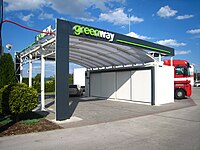
Bombardment Swap Station for light commercial vehicles in Slovakia
-

Loading a Voltia electric LKW battery pack
Other bombardment swapping service providers include Gogoro, Delta Electronics, BattSwap,[ citation needed ] and Voltia.[93] [94] As of March 2022[update], NIO has 836 swap stations in Red china,[95] up from 131 in 2020.[96] A station can price $772,000 in China. A ninety kWh battery is charged at sixty kW and can be swapped in 6 minutes.[95] Prc operates cement trucks where the heavy battery is swapped.[97] A battery swap organisation with a 2MWh battery in each xx-foot shipping container powering a converted culvert barge began operating in the Netherlands in 2021.[98] [99]
Criticism [edit]
Bombardment swapping solutions were criticized as proprietary. By creating a monopoly regarding the ownership of the batteries and the patent protected technologies the companies split upwardly the market and decrease the chances of a wider usage of battery swapping.[100]
Sites [edit]

Motorcar connected to an EV charger over a parking space
Charging stations tin can be placed wherever electric power and adequate parking are bachelor. Residences are past far the nearly mutual charging location.[101] Home charging stations typically lack user hallmark and separate metering, and may require a defended circuit.[102] Some portable charging cable can be wall mounted. In addition to home stations, public stations have been sited along highways, in shopping centers, hotels, government facilities and at workplaces. Some gas stations offer EV charging stations.[103] Some charging stations take been criticized as inaccessible, hard to find, out of order, and slow, thus slowing EV adoption.[104]
Public charge stations may charge a fee or offer free service based on regime or corporate promotions. Accuse rates vary from residential rates for electricity to many times higher, the premium is usually for the convenience of faster charging. Vehicles tin typically be charged without the owner present, allowing the possessor to partake in other activities.[105] Sites include malls, freeway remainder stops, transit stations, regime offices, etc.[106] [107] Typically, AC Type ane/Type two plugs are used. Mobile charging involves some other vehicle that brings the charge station to the Electrical vehicle, the ability is supplied via a fuel generator(typically gasoline or diesel), or a big bombardment. Wireless charging uses inductive charging mats that charge without a wired connection and can exist embedded in parking stalls or even on roadways.
An offshore electricity recharging system named Stillstrom, to be launched by Danish shipping firm Maersk Supply Service, will requite ships admission to renewable energy while at sea.[108] Connecting ships to electricity generated by offshore current of air farms, Stillstrom is designed to cut emissions from idling ships.[108]
[edit]
Smart grid [edit]
A smart filigree is one that can arrange to changing conditions by limiting service or adjusting prices. Some charging stations can communicate with the grid and actuate charging when conditions are optimal, such as when prices are relatively low. Some vehicles let the operator to control recharging.[109] Vehicle-to-grid scenarios allow the vehicle battery to supply the grid during periods of peak demand. This requires communication betwixt the grid, charging station, and vehicle. SAE International is developing related standards. These include SAE J2847/1.[110] [111] ISO and IEC are developing similar standards known as ISO/IEC 15118, which too provide protocols for automatic payment.
Renewable energy [edit]
Charging stations are typically connected to the filigree, which in near jurisdictions relies on fossil-fuel ability stations. Yet, renewable energy may be used to reduce the use of grid energy. Nidec Industrial Solutions has a organization that tin exist powered by either the grid or renewable free energy sources like PV.[ citation needed ] In 2009, SolarCity marketed its solar free energy systems for charging installations. The visitor announced a single demonstration station in partnership with Rabobank on Highway 101 between San Francisco and Los Angeles.[112]
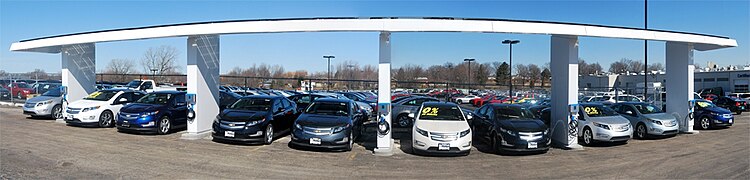
The East-Move Charging Station is equipped with eight monocrystalline solar panels, which can supply i.76kW of solar power.[113]
In 2012, Urban Green Energy introduced the world's first current of air-powered electric vehicle charging station, the Sanya SkyPump. The pattern features a 4kW vertical-axis wind turbine paired with a GE WattStation.[114]
In 2021 Nova Innovation introduced the world'due south first direct from tidal ability EV charge station. World'southward get-go tidal energy powered EV charger launched in Shetland
See as well [edit]
References [edit]
- ^ Reardon, William A. (1973). The energy and resource conservation aspects of electric vehicle utilization for the City of Seattle. Richland, WA: Battelle Pacific Northwest Laboratories. pp. 28–29.
- ^ "ACEA position and recommendations for the standardization of the charging of electrically chargeable vehicles" (PDF). ACEA – European Automobile Manufacturers Association. two March 2011. Archived (PDF) from the original on 2 December 2012.
- ^ "NEC 1999 Commodity 625 - Electric Vehicle Charging System". National Electric Code. 1999. Retrieved 2 September 2021.
- ^ a b c d eastward f g "Electric Vehicle Charging Equipment Installation Guide" (PDF). Land of Massachusetts, Partitioning of Energy Resources. January 2000. Archived from the original (PDF) on 2 September 2000.
- ^ "Infrastructure Working Council". Electrical Power Research Plant. Retrieved 2 September 2021.
- ^ "SAE Electric Vehicle and Plug in Hybrid Electrical Vehicle Conductive Accuse Coupler". SAE International. 13 October 2017. Retrieved 1 January 2019.
- ^ a b c "What's the Departure Between EV Charging Levels?". FreeWire Technologies. 1 July 2020. Retrieved 26 March 2021.
- ^ "What is Fast Charging". chademo.com. CHAdeMO Clan. Retrieved 29 Nov 2017.
- ^ "IEC 61851-1:2017 Electrical vehicle conductive charging system, Part 1: General requirements". International Electrotechnical commission. Retrieved 11 August 2021.
- ^ "Charging modes (IEC-61851-one)". Circutor . Retrieved 10 August 2021.
- ^ Ferrari, Lorenzo. "Charging modes for electric vehicles". Daze Technology . Retrieved 10 August 2021.
- ^ "Directive 2014/94/EU on the deployment of culling fuels". 28 Oct 2014. Retrieved 15 Baronial 2021.
- ^ "Understanding Electric Vehicle Charging – Plug In America". Plug In America. 31 Jan 2011. Retrieved 29 Nov 2017.
- ^ "TSLA Q4 Update" (PDF). tesla-cdn.thron.com. Archived (PDF) from the original on 26 Jan 2022. Retrieved 17 Feb 2022.
- ^ a b "CharIN HPCCV Task Force: High Power Plug Update [PDF]". CharIN. April 2020. Retrieved 24 August 2021.
- ^ "CharIN Develops Super Powerful Charger With Over 2 MW Of Ability". InsideEVs.
- ^ CharIN High Power Commercial Vehicle Charging Task Forcefulness Aggregated Requirements (PDF) (Report). CharIN. 18 Feb 2019. Archived from the original (PDF) on 10 July 2019.
- ^ "The CharIN path to Megawatt Charging (MCS): Successful connector test event at NREL" (Press release). CharIN. 13 October 2020. Retrieved 24 August 2021.
- ^ Gehm, Ryan (27 May 2021). "Mega push for heavy-duty EV charging". Truck & Off-Highway Engineering. Society of Automotive Engineers. Retrieved 24 Baronial 2021.
- ^ "Daimler Trucks Due north America, Portland General Electric open showtime-of-its-kind heavy-duty electric truck charging site" (Press release). Daimler Trucks North America. 21 April 2021. Retrieved 24 August 2021.
- ^ Edelstein, Stephen (16 May 2021). "This electric truck stop won't offer gas or diesel fuel—merely 25 MW of solar-supplemented charging". Green Motorcar Reports . Retrieved 24 August 2021.
- ^ Hosseini, Seyed Hossein (May 2020). "An Extendable Quadratic Bidirectional DC–DC Converter for V2G and G2V Applications". IEEE Transactions on Industrial Electronics. 68 (6): 4859–4869. doi:ten.1109/Necktie.2020.2992967. hdl:10197/12654. ISSN 1557-9948. S2CID 219501762.
- ^ "A Simple Guide to DC Fast Charging". Fleetcarma.com. Archived from the original on 26 December 2017. Retrieved 5 October 2017.
- ^ Pyper, Juliet (24 July 2013). "Charger standards fight confuses electric vehicle buyers, puts car company investments at risk". ClimateWire. E&E Publishing, LL. Retrieved 29 July 2013.
- ^ "News Archive 1". Magne Charge. December 2000. Archived from the original on ii March 2001.
- ^ "News Archive 2". Magne Charge. Dec 2000. Archived from the original on two March 2001.
- ^ a b c d east Staff Report: Initial Statements of Reasons (PDF) (Report). California Air Resources Board. eleven May 2001. Retrieved 2 September 2021.
- ^ "ARB Amends ZEV Rule: Standardizes Chargers & Addresses Automaker Mergers" (Press release). California Air Resources Board. 28 June 2001. Retrieved 2 September 2021.
- ^ "GM Pulls the Plug on Inductive Charging". EV1 Club. GM Avant-garde Technology Vehicles - Torrance Operations. 15 March 2002. Archived from the original on 28 January 2004.
- ^ "SAE J1772 Overview based on the OLD 2001 version of SAE J1772". Modular EV Power LLC. 2009. Retrieved two September 2021.
- ^ "SAE Committee Selects Conductive Technology for Utilise As a Universal Electric Vehicle Charging Standard" (Press release). Club of Automotive Engineers, Electric Vehicle Charging Systems Committee. 27 May 1998. Retrieved 2 September 2021.
- ^ "Component Products". Avcon. 28 June 2001. Archived from the original on 13 August 2001.
- ^ "SAE J1772 Compliant Electric Vehicle Connector". Electric Vehicles News. Retrieved 2 September 2021.
- ^ "Who killed the electric grid? Fast-charging electric cars". LOW-TECH MAGAZINE.
- ^ "Guide to buy the correct EV home charging station". United states of america: Home Charging Stations. iii Jan 2018. Retrieved 1 September 2018.
- ^ "Bordcomputer: Wie genau ist die Verbrauchsanzeige?". world wide web.adac.de (in German). Retrieved 20 October 2020.
- ^ "Fuel Efficiency for 2020 Tesla Model South Long Range". U.S. Environmental Protection Bureau. Retrieved 12 April 2021.
- ^ "Plug-In 2008: Company News: GM/V2Green/Coulomb/Google/HEVT/PlugInSupply". CalCars. 28 July 2008. Retrieved 30 May 2010.
- ^ Source: Us Section of Transportation, Bureau of Transportation Statistics, Autobus Household Survey. Data from the February, Apr, June, and Baronial 2003 surveys have been combined. Information cover activities for the calendar month prior to the survey. (Oct 2003). "From Domicile to Work, the Average Commute is 26.4 Minutes" (PDF). OmniStats. three (iv). Archived from the original (PDF) on 12 May 2009. Retrieved 15 October 2009.
{{cite journal}}: CS1 maint: multiple names: authors list (link) - ^ "Electrical vehicles – Virtually electric vehicles – Charging – suppliers". london.gov.united kingdom. 2009. Archived from the original on 5 April 2012. Retrieved 24 Nov 2011.
- ^ a b c International Energy Bureau, Clean Free energy Ministerial, and Electrical Vehicles Initiative (Apr 2013). "Global EV Outlook 2013 – Understanding the Electric Vehicle Landscape to 2020" (PDF). International Energy Agency. Archived from the original (PDF) on 23 April 2013. Retrieved 20 April 2013.
{{cite web}}: CS1 maint: multiple names: authors list (link) See pp. fourteen-15. - ^ "CHAdeMO Association". Retrieved 16 July 2015.
- ^ Bräunl, Thomas (16 September 2013). "Setting the standard: Australia must choose an electric car charging norm". The Conversation Australia . Retrieved 16 September 2013.
- ^ Palin, Adam (19 November 2013). "Infrastructure: Shortage of electrical points puts the brake on sales". Financial Times . Retrieved 28 December 2013.
- ^ KredEx (20 February 2013). "Estonia becomes the beginning in the world to open a nationwide electrical vehicle fast-charging network". Estonian World. Retrieved 28 December 2013.
- ^ Vaughan, Adam (20 February 2013). "Estonia launches national electric machine charging network". The Guardian . Retrieved 28 December 2013.
- ^ Renault (17 December 2012). "Renault delivers first ZOE EV" (Press release). Green Car Congress. Retrieved 17 December 2012.
- ^ "Ladepunkter i Norge" [Charge Points in Norway] (in Norwegian). Grønn bil. Archived from the original on 26 April 2012. Retrieved x April 2013.
- ^ Toor, Amar (10 July 2013). "Every Dutch citizen will live inside 31 miles of an electrical vehicle charging station past 2015". The Verge. Vox Media. Retrieved 11 July 2013.
- ^ Stichting E-laad (21 Jan 2014). "Ondersteuning laadinfrastructuur elektrische auto's wordt voortgezet". Retrieved 26 May 2014.
- ^ a b "The hereafter of due east-mobility is now". European Investment Bank . Retrieved 14 July 2021.
- ^ "Petrol and diesel fuel motorcar sales ban brought forwards to 2035". BBC. Retrieved 6 March 2022.
- ^ "Utilities, states work together to aggrandize EV charging infrastructure". Daily Energy Insider. 13 August 2018. Retrieved 30 August 2018.
- ^ U.s.a. Section of Free energy (9 April 2013). "Alternative Fueling Station Counts past State". Culling Fuels Data Center (AFDC). Retrieved x April 2013. The AFDC counts electrical charging units or points, or EVSE, as one for each outlet available, and does not include residential electric charging infrastructure.
- ^ Rex, Danny (10 April 2013). "US public charging stations increase by 9% in get-go quarter". Autoblog Green . Retrieved x Apr 2013.
- ^ "Supercharger | Tesla". world wide web.tesla.com . Retrieved 9 July 2020.
- ^ Halvorson, Bengt (xx August 2019). "Green Motorcar Reports". Retrieved 12 September 2019.
- ^ Electric Vehicles, Manitoba Hydro, retrieved 2 April 2013,
Manitobans' experience with cold atmospheric condition and plugging in their vehicles will help ease the transition to adopting PEVs. In some circumstances, the existing infrastructure used to power vehicle block heaters in the winter tin can besides be used to provide limited charging for PEVs. However, some existing electrical outlets may not be suitable for PEV charging. Residential outlets can be function of a circuit used to power multiple lights and other electrical devices, and could become overloaded if used to charge a PEV. A dedicated circuit for PEV charging may demand to be installed by a licensed electrician in these situations. Besides, some commercial parking lot outlets operate in a load restricted or cycled manner and using them may consequence in your PEV receiving a lower charge than expected or no charge at all. If a parking stall is not specifically designated for PEV utilize, nosotros recommend that y'all consult with the parking lot or building managing director to ensure it can provide adequate power to your vehicle.
- ^ Park and Ride Locations, Calgary Transit, 16 April 2009, archived from the original on 19 September 2010, retrieved 25 April 2009,
The plug-ins located in the Park and Ride lots automatically turn on when the exterior temperature falls below −20 degrees and turn off and on in increments to save electricity usage.
- ^ "Supercharger | Tesla". www.tesla.com . Retrieved 28 November 2017.
- ^ "Supercharging". www.tesla.com . Retrieved 28 November 2017.
- ^ "Electric Vehicle Charging". Blink CarCharging . Retrieved 28 November 2017.
- ^ "Commuter FAQ". ChargePoint . Retrieved 29 November 2017.
- ^ "Charging stations in Due south Africa". Electromaps . Retrieved 5 Nov 2021.
- ^ El ámbito (24 April 2017). "Repsol back on rails on YPF road: now for electrical cars". Retrieved 27 Apr 2017.
- ^ "EVPlug Alliance". Archived from the original on ane August 2015. Retrieved 16 July 2015.
- ^ "MENNEKES – Plugs for the world: The solution for Europe: blazon 2 charging sockets with or without shutter". Archived from the original on xvi July 2015. Retrieved xvi July 2015.
- ^ IEC 62196-1
- ^ IEC 61851-1
- ^ "Industrial electrical vehicle stalwarts head out on the road". Archived from the original on 16 July 2011. Retrieved 24 Oct 2010.
- ^ "Trucking'southward Eclipsed Electric Age". The Lost Annals of Transport. William B. Cassidy. Retrieved 26 October 2015.
- ^ Kirsch, David A. (2000). The Electric Vehicle and the Brunt of History . Rutgers Academy Press. pp. 153–162. ISBN0-8135-2809-vii.
- ^ "BIT Attends the Delivery Ceremony of the 2008 Olympic Games -Alternative Fuel Vehicles". Beijing Institute of Technology. 18 July 2008. Retrieved two June 2013.
- ^ "Technology : Something New Under the Hawaiian Lord's day: a Solar Motorcar : Japan will import upwardly to 2,000 SunRay zero-emission vehicles. Assembly will take identify at a quondam sugar plantation town". Los Angeles Times. 5 April 1995.
- ^ "Budd Steinhilber, FIDSA". Industrial Designers Society of America - IDSA. 10 May 2010.
- ^ "Honolulu Star-Bulletin Features". archives.starbulletin.com.
- ^ "The Bout de Sol Reports, 2004". www.autoauditorium.com.
- ^ Blanco, Sebastian (27 September 2009). "Report: Tesla Model S was designed with battery swaps in mind". Autoblog Dark-green. Retrieved 22 June 2013.
- ^ "Mitsubishi working on bombardment swapping for transit buses, Amend Place not involved".
- ^ Siler, Steve (21 June 2013). "Tesla launches battery-swapping service for 2-minute recharging". Yahoo Autos . Retrieved 23 June 2013.
- ^ Light-green, Catherine (21 June 2013). "Tesla shows off its battery-swapping station: 90 seconds and less than $100". Silicon Valley Mercury News . Retrieved 23 June 2013.
- ^ "Tesla shuts down battery swap program in favor of Superchargers, for now". www.teslarati.com . Retrieved xviii April 2018.
- ^ a b Udasin, Sharon (24 March 2011). "Better Identify launches 1st Israeli battery-switching station". The Jerusalem Mail . Retrieved 25 March 2011.
- ^ a b c Rogowsky, Marker (21 June 2013). "Tesla 90-2d Bombardment Bandy Tech Coming This Year". Forbes . Retrieved 22 June 2013.
- ^ "Better Place, battery switch station clarification". Archived from the original on 14 August 2012.
- ^ "Better Place'south Renault Fluence EV to sell for under $20,000".
- ^ "Better Identify. The Renault Fluence ZE". Better Identify. 22 October 2010. Archived from the original on 12 September 2010. Retrieved 22 Oct 2010.
- ^ Motavalli, Jim (29 July 2011). "Plug-and-Play Batteries: Trying Out a Quick-Swap Station for E.5.'s". The New York Times . Retrieved 23 June 2013.
- ^ Kershner, Isabel (26 May 2013). "Israeli Venture Meant to Serve Electric Cars Is Ending Its Run". The New York Times . Retrieved 27 May 2013.
- ^ Elis, Niv (26 May 2013). "Death of Amend Identify: Electrical car co. to dissolve". The Jerusalem Post . Retrieved 30 May 2013.
- ^ "Tesla Motors demonstrates battery swap in the Model S". Light-green Automobile Congress. 21 June 2013. Retrieved 22 June 2013.
- ^ Sorokanich, Robert (ten June 2015). "Musk: Tesla "unlikely" to pursue battery swapping stations". Road & Track . Retrieved 26 October 2015.
- ^ Voltia Group (2 December 2015), Companies successfully using the GreenWay Service, archived from the original on fifteen December 2021, retrieved 25 Apr 2017
- ^ "Electric-Car Battery Swapping, Slovakian Manner (Well, Vans, Anyway)". Green Car Reports . Retrieved 25 April 2017.
- ^ a b "Could battery swapping replace EV charging?". Autocar. 4 April 2022. Archived from the original on 4 Apr 2022. Retrieved 4 Apr 2022.
- ^ Hanley, Steve (31 May 2020). "NIO Completes More than Than 500,000 Bombardment Swaps". CleanTechnica.
- ^ Doll, Scooter (fifteen March 2022). "Geely is rolling out swap stations for heavy duty EVs similar cement mixers, housing three-ton bombardment packs". Electrek.
- ^ "First emission-free inland shipping vessel on free energy containers in service". Port of Rotterdam. 6 September 2021.
- ^ Berrill, Paul (7 September 2021). "Heineken refreshes the batteries other shippers can't attain | TradeWinds". TradeWinds | Latest shipping and maritime news.
- ^ "Tesla battery bandy a dead stop". 21 June 2013. Retrieved 12 February 2014.
- ^ "Charging at Home". Energy.gov . Retrieved three October 2019.
- ^ Stenquist, Paul (11 July 2019). "Electric Chargers for the Home Garage". The New York Times . Retrieved 3 Oct 2019.
- ^ Peters, Adele (8 October 2018). "Want electrical vehicles to scale? Add together chargers to gas stations". Fast Company . Retrieved 26 March 2021.
- ^ Shahan, Zachary (22 July 2017). "Tesla Superchargers vs … Ugh". CleanTechnica . Retrieved 23 July 2017.
needs to be washed to make a charging network or but individual charging stations adequate for EV drivers .. enough of complaints about such inaccessible charging stations .. it tin can have what seems like ages to actually find the station because of how invisible it is .. some charging stations are down fifty% of the fourth dimension .. Unless yous're willing to increase your travel time by ≈fifty%, charging at l kW on a road trip doesn't really cut information technology ..
- ^ Savard, Jim (16 Baronial 2018). "Is information technology Time to Add Electrical Vehicle Charging Stations to Your Retail Shopping Middle?". Metro Commercial . Retrieved 3 October 2019.
- ^ "Alternative Fuels Information Centre: Workplace Charging for Plug-In Electric Vehicles". afdc.energy.gov . Retrieved iii October 2019.
- ^ Siddiqui, Faiz (fourteen September 2015). "At that place are at present more places to charge your electrical vehicle in Maryland — for gratuitous". The Washington Mail . Retrieved iii Oct 2019.
- ^ a b Wallace, Abby (xx Feb 2022). "These floating charging points will permit ships depict electricity from offshore air current farms – and could recharge battery-powered vessels of the future". Business Insider. Archived from the original on 20 February 2022.
- ^ "Tesla Motors Introduces Mobile App for Model S Sedan". six Feb 2013.
- ^ "SAE Ground Vehicle Standards Status of work – PHEV +" (PDF). SAE International. January 2010. pp. 1–7. Archived from the original (PDF) on 29 September 2012. Retrieved iii September 2010.
- ^ "J2931/1B (WIP) Digital Communications for Plug-in Electric Vehicles - SAE International". www.sae.org.
- ^ "SolarCity Installs Electric Machine Chargers Forth Cal Highway". 22 September 2009. Retrieved 16 July 2015.
- ^ "Eco Tech: E-Move Charging Station fuels but virtually everything with solar energy". Archived from the original on 27 February 2012. Retrieved vii April 2012.
- ^ "Sanya Skypump: World's first air current-fueled EV charging station – Digital Trends". Digital Trends. fourteen August 2012. Retrieved xvi July 2015.

How Much Do Vehicle Charging Systions Draw,
Source: https://en.wikipedia.org/wiki/Charging_station
Posted by: limaftere1980.blogspot.com
0 Response to "How Much Do Vehicle Charging Systions Draw"
Post a Comment